"We have to ensure that students grow up knowing who they are."
The Dean's Distinguished Lecture with Senator Murray Sinclair – November 19, 2019 at 7:00 p.m.
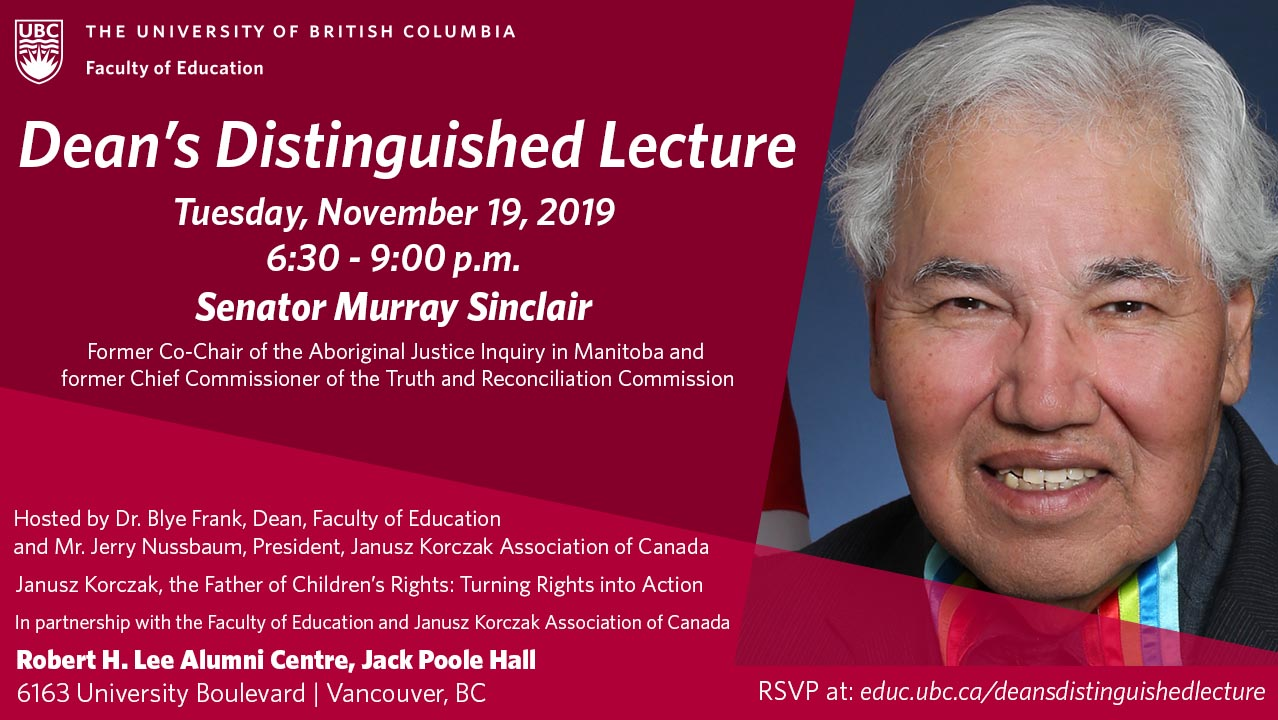
The presentation starts at about the 35 minute mark in the recording.
===========


A personal reflection:
Why do we acknowledge territory? It has become a common practice at the start of official events in schools, municipalities and at community cultural celebrations. While some may say that the acknowledgment statement has become a simple formality, it is also an important opportunity to advance the cause of Reconciliation, and give us all a context for the work we do our everyday lives.
I think the more we can personalize what this means, the easier it is for students and staff to understand how important acknowledgement statements can be.
When we think about the history of a place, the city we live in, our province or the country as a whole, I am reminded that the colonial history is not very deep. We think of Canada as being established in 1867, but even that date only refers to the smaller, initial group of provinces.
When my parents, who were both born in Newfoundland, and who moved to the BC coast later in life met people new to Canada, and the conversation turned to who was not born here, my parents both raised their hands. And when asked where they are from, they responded "Newfoundland!" When someone invariably pointed out that Newfoundland is in fact part of Canada, they loved to say "Not when we were born there it wasn't."
My parents loved to have a bit of fun with this, but for me, it is a very real reminder of the short history of the country we live in. It means that Canada, with its 10 provinces including Newfoundland, is younger than my mother! (pause for effect!)
The Canadian history that lies upon this land is very young, and the roots are really not that deep. Imagine, a country that is younger than my mother! But the archeological digs done recently in Pitt Meadows (ancient Wapato Gardens) tell us about infrastructure work done by the Katzie people 3800 years ago, and discoveries on Triquet Island (ancient firepits) testify to 14,000 years of repeated occupation by the Heiltsuk.
The roots of Indigenous people stretch back thousands of years, and acknowledgement of territory is an opportunity for all of us to recognize the depth of that history and to remember that those people (myself included) are still here today. And so, when I take a moment at my job site in Surrey BC to acknowledge that we are meeting, working and learning, on the shared traditional territory of the Katzie, Semiahmoo and Kwantlen First Nations, a land with deep roots and a unique culture, it helps provide an important context for the ongoing educational work that I do.
===========================


"I graduated from Syracuse University in 2017 with a BFA in Illustration and a minor in Indigenous Studies. I'm always trying to improve my art, as well as learning each variation of our Haudenosaunee legends. For the past two years I've been traveling around and educating people about the Haudenosaunee culture and teachings while funding my art and myself, as they're one in the same," said David.